Occurs in open ocean and near deep-water margins across major basins. Eastern Pacific tagging recorded seasonal movement, use of upwelling fronts and dives beyond 500 m by some individuals. [3]
NOAA reports adults reaching about 3 m and up to 2,200 kg. These are reported maxima, not typical dimensions for every individual. [2]
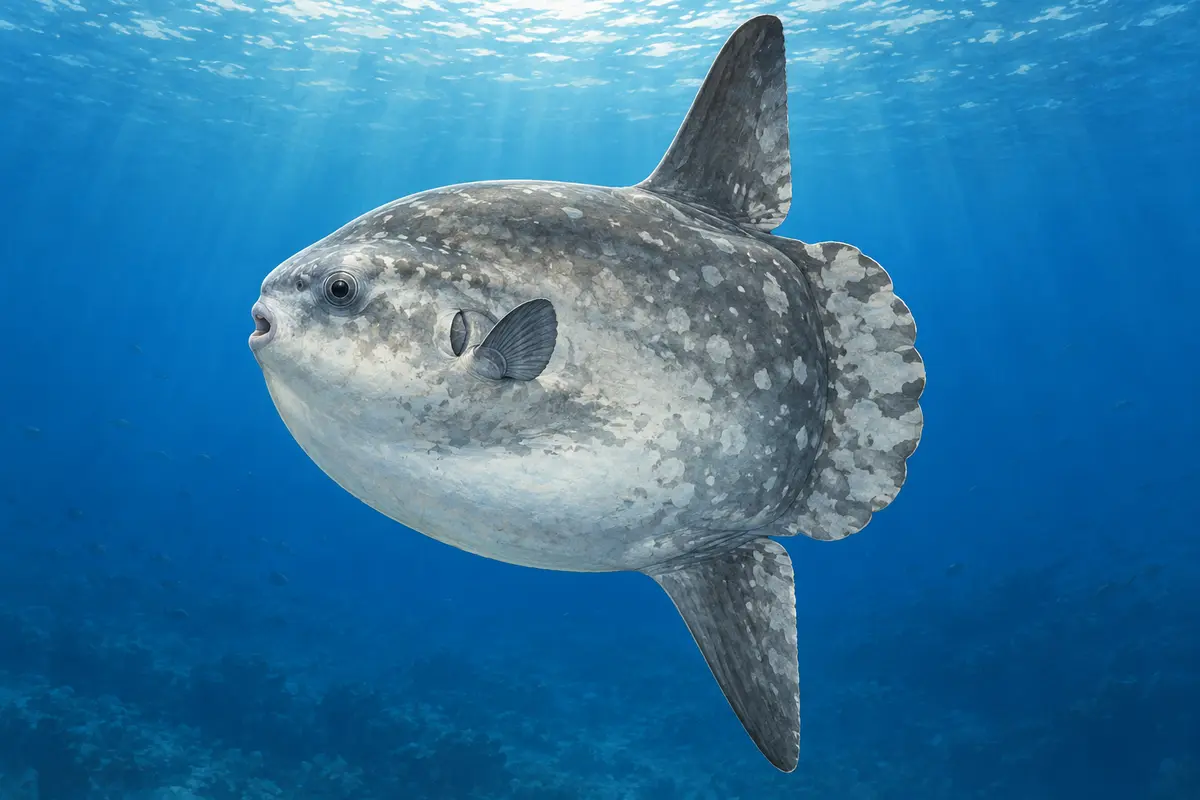
The body is nearly circular and laterally compressed; dorsal and anal fins are very tall, while the tail is replaced by a rounded clavus. The mouth is small, pectorals short and skin mottled grey. [2,4]
The compressed body and enormous vertical fins create a distinctive propulsion system; larvae pass through spiny forms before developing the adult disc shape. [4,5]
Behaviour and ecology
It swims by synchronously flapping dorsal and anal fins; it may lie near the surface yet also dives deeply and travels actively. Its unusual shape does not mean it merely drifts. [3,4]
Diet
It consumes soft-bodied plankton such as jellyfish and salps plus other water-column prey. Tagging links foraging habitat with plankton-rich upwelling fronts. [3,6]
Reproduction and life cycle
Females produce enormous numbers of small eggs; FishBase records about 300 million in a 1.5 m female and mixed oocyte stages suggesting multiple spawning. Early-life biology remains poorly known. [4,5]
Ecosystem role
A major consumer of gelatinous organisms in marine food webs, it also carries parasites taken by cleaner fish and seabirds. Ecosystem effects vary by region. [3,6]
Threats & conservation
Bycatch in driftnets and other fisheries is a major pressure; NOAA research found it could dominate bycatch in one California drift-gillnet fishery. That proportion should not be generalised globally. [3]
Reviewed 21 October 2026: the IUCN species page was cross-checked as VU, although full assessment detail did not load. The species was not located in the current CITES check; this does not replace fisheries or national law. [1,5]5 sourced facts
Species in five facts
It can reach about 2,200 kg. [2]
The conventional tail is replaced by a clavus. [4]
Dorsal and anal fins work together for propulsion. [4]
Tagged individuals have dived beyond 500 m. [3]
Larval biology still contains major knowledge gaps. [5]
Sources
[1] IUCN Red List — Mola mola[2] NOAA Ocean Exploration — Ocean Sunfish[3] NOAA repository — ecology and satellite tagging[4] FishBase — Mola mola summary[5] Australian Museum — Ocean Sunfish[6] NOAA National Marine Sanctuaries — Mola diet