
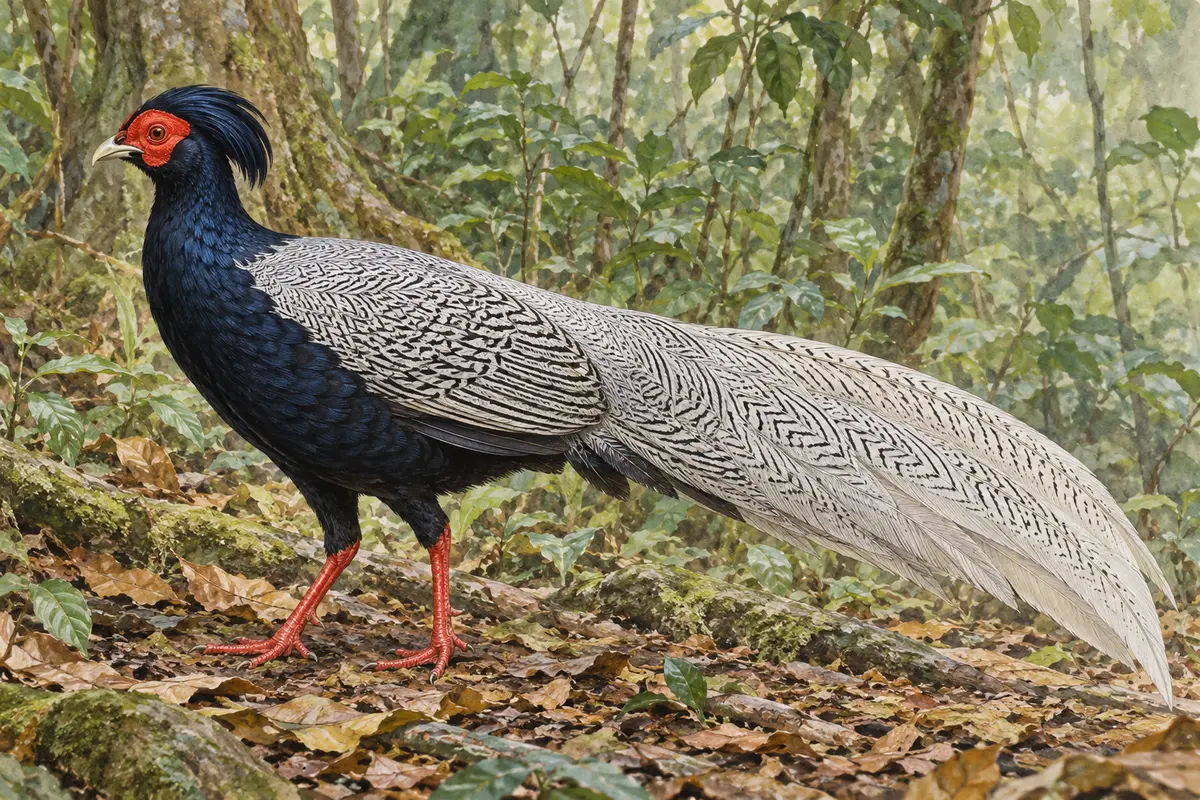
Avibase places annamensis in montane forest of southern Vietnam. This narrow range differs from the broad species range from southern China through mainland South-East Asia. [1,3]
No robust public standard measurements were located specifically for annamensis. At species level, southern males are smaller than northern forms; this profile does not assign the maximum of large forms to this subspecies. [3]
Males have glossy blue-black crest and underparts, red facial skin and legs, a long tail, and heavily black-vermiculate grey-white upperparts. Females are brown with red facial skin. [3,4]
Strong legs rake litter, a compact body moves through understorey and brown female plumage aids camouflage; the male's long tail and contrast serve display. [4,5]
Behaviour and ecology
A forest-floor bird that walks while foraging and bursts into strong short flight when disturbed. Shy behaviour and leaf litter make wild detection difficult. [3,4]
Diet
Species-level evidence indicates an omnivorous diet of seeds, fruits, shoots, young leaves and litter invertebrates. The annamensis-specific diet needs further study. [4,5]
Reproduction and life cycle
At species level, females make a shallow ground nest and incubate for just under a month. Evidence was insufficient for an annamensis-specific clutch size or seasonal calendar. [5]
Ecosystem role
Fruit, seed and invertebrate feeding links the bird to plant recruitment and forest-floor nutrient cycles; eggs and young also support forest predators. [4,5]
Threats & conservation
Although the parent species is LC, annamensis has a small range and is described as rare; forest loss, trapping and captive hybridisation are risks. Management should retain subspecies-level pedigrees. [1,3]
Reviewed 22 October 2026: IUCN/BirdLife assesses Lophura nycthemera as LC; no separate global assessment was located for annamensis. The name was not located in the CITES Appendices effective 5 March 2026; that is not trade permission. [1,2]5 sourced facts
Species in five facts
This subspecies is endemic to southern Vietnam's montane forests. [3]
Annamensis males are darker than many northern forms. [3,4]
Both sexes have red facial skin. [4]
At species level, females use shallow ground nests. [5]
IUCN's LC category applies to the parent species, not a separate annamensis assessment. [1]
Sources
[1] BirdLife DataZone — Lophura nycthemera[2] CITES — Appendices valid from 5 March 2026[3] Avibase — Lophura nycthemera and subspecies ranges[4] Thai National Parks — Silver pheasant[5] Shubenacadie Wildlife Park — Silver pheasant