
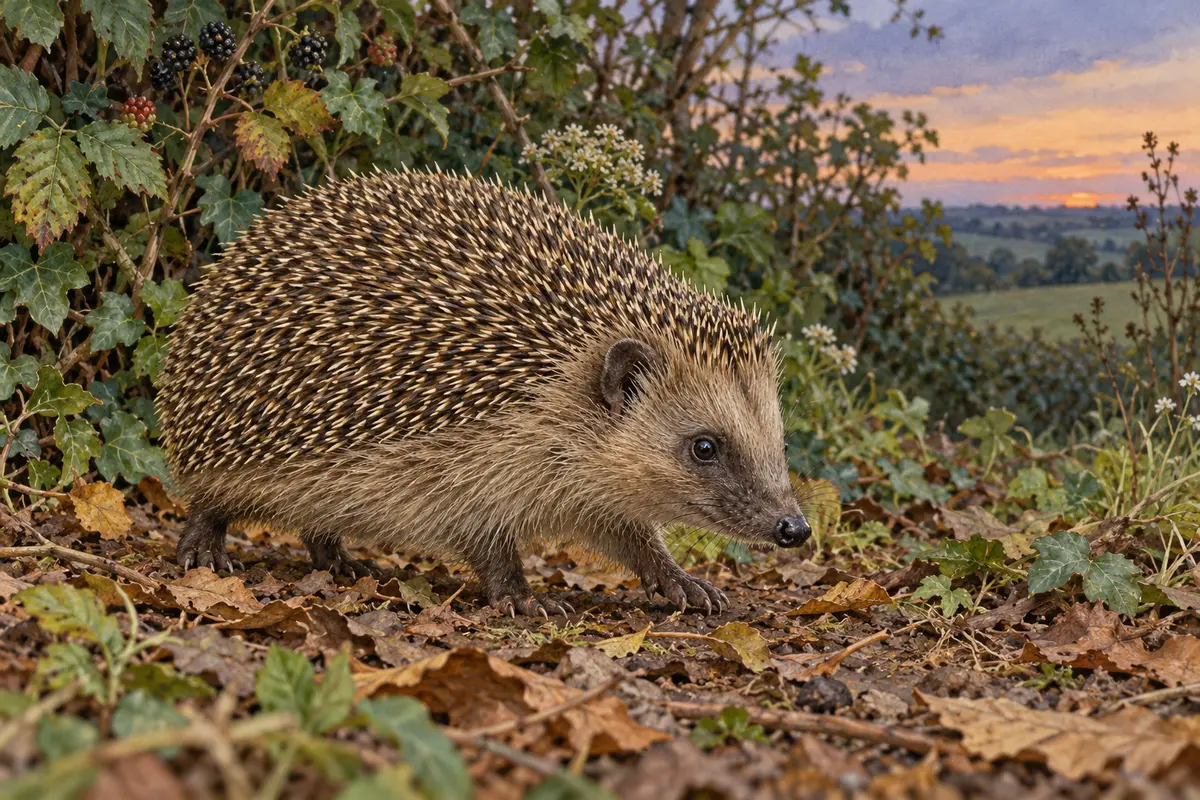
Widespread in western and central Europe, using woodland edges, hedgerows, farmland, parks and gardens. Connected landscapes allow movement between forage and shelter. [1]
Head–body length is about 15–30 cm, tail 1–2 cm and mass can reach 2 kg. Weight varies strongly with season, age and pre-hibernation condition. [1]
The back carries roughly 5,000–7,000 short cream-brown spines; face, belly and legs have coarse grey-brown fur. The snout is pointed, ears small, and the spines cannot be fired. [1]
Subcutaneous muscles raise the spines and roll the body to protect soft tissues; hibernation lowers heart rate, breathing, body temperature and metabolism through food-poor months. [1]
Behaviour and ecology
Solitary and nocturnal, resting by day in leaf nests. In cold months it may hibernate in an insulated hibernaculum, while still occasionally waking and moving. [1]
Diet
Feeds mainly on invertebrates such as beetles, earwigs, earthworms and caterpillars, with occasional carrion and ground-nesting bird eggs. Milk is unsuitable because hedgehogs are lactose-intolerant. [1]
Reproduction and life cycle
Matures at around one year; mating occurs mainly from April to September. Gestation lasts about a month, litters often contain 3–7 young, and independence comes at around eight weeks. [1]
Ecosystem role
It consumes many invertebrate groups and is a useful indicator of landscapes with healthy soil, litter and green corridors. It is a broad indicator, not a stand-alone soil metric. [1]
Threats & conservation
Hedgerow and habitat loss, pesticides, impermeable fences, urban development and traffic drive declines. Global NT reflects widespread decline while regional data uncertainty remains. [1,2]
Reviewed 21 October 2026: the Mammal Society reports the global IUCN update from LC to NT. The species was not located in the current CITES check; local wildlife and veterinary rules still require review. [1,2]5 sourced facts
Species in five facts
Spines are modified keratin hairs. [1]
An individual usually carries about 5,000–7,000 spines. [1]
A young hedgehog is called a hoglet. [1]
Wild individuals often live 2–3 years. [1]
The global IUCN status was updated to Near Threatened. [2]
Sources
[1] Mammal Society — European hedgehog[2] Mammal Society — IUCN update to Near Threatened