
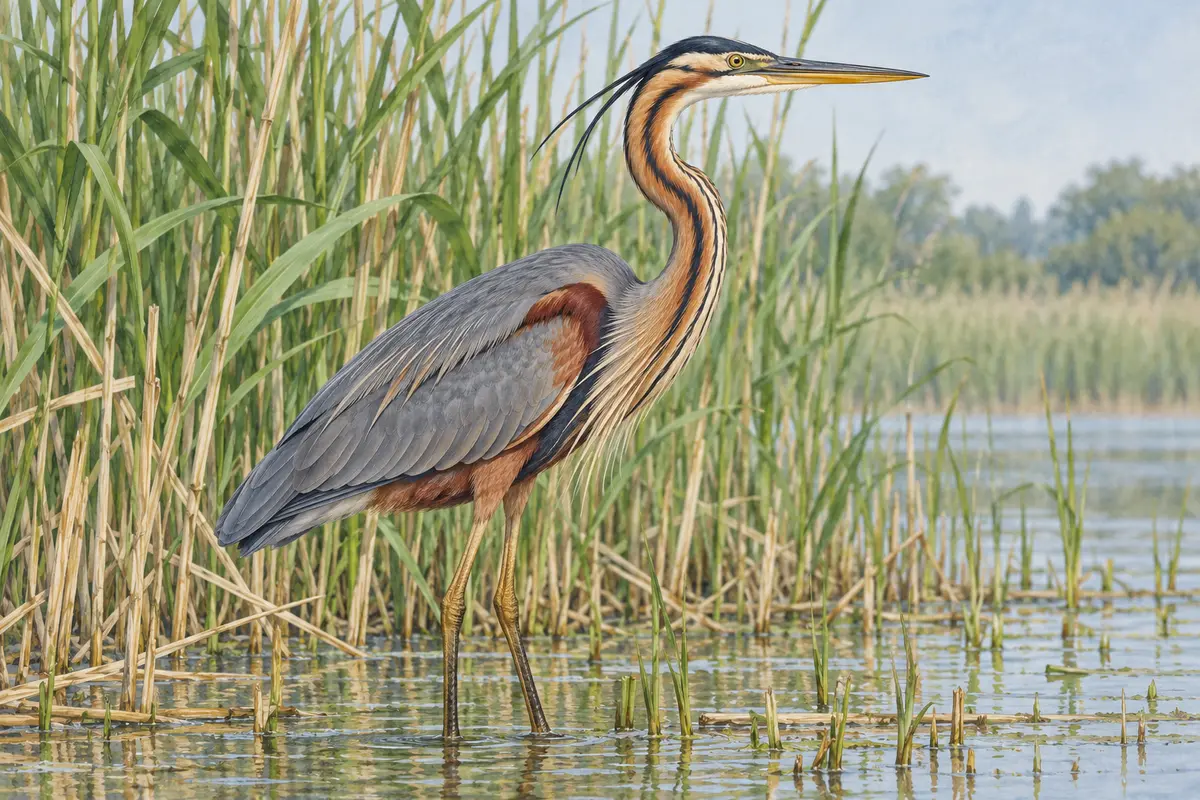
Widespread across Africa, central and southern Europe and southern/eastern Palearctic regions; temperate populations migrate while many tropical populations are resident. It favours shallow marshes, lakes, canals and dense reedbeds. [1,2]
BTO gives a reference mass of 873.8 g. It is slender and generally smaller than a Grey Heron; size alone should not establish identification. [1]
The buff-chestnut head and neck carry black stripes; the black crown forms crest plumes, shoulders are chestnut and wings grey. When alert, the slender neck may stretch vertically among reeds. [1,2]
A long neck, pointed bill and tall legs support striking through reeds and shallow water. Longitudinal plumage stripes break up the body outline among stems. [1,2]
Behaviour and ecology
It hunts by standing still or walking slowly within waterside vegetation; its secretive nature makes breeding confirmation harder than for more exposed herons. [1,2]
Diet
It takes fish, amphibians, aquatic insects and other small animals in shallow water or reed margins, varying by region and season. [2]
Reproduction and life cycle
Usually one brood of 3–5 eggs; both parents incubate for about 25–30 days and young fledge after roughly 45–50 days. These are BTO biological data, not captive-breeding instructions. [1]
Ecosystem role
It is a mid-level wetland predator associated with shallow-water and reedbed habitat quality. A single occurrence should not be treated as a complete ecosystem-health indicator. [1,2]
Threats & conservation
Global LC does not exclude regional declines; wetland drainage, reedbed loss and nesting disturbance are major pressures. Conservation requires suitable water levels, connected reeds and quiet buffers. [2,3]
Reviewed 21 October 2026: BTO/BirdLife report global LC. The species name was not located in the current CITES check; this is not a conclusion that permits or national laws do not apply. [1,3]5 sourced facts
Species in five facts
BTO gives a reference mass of 873.8 g. [1]
Both parents incubate. [1]
A typical clutch has 3–5 eggs. [1]
Young typically fledge after about 45–50 days. [1]
The species is covered by Afro-Eurasian migratory-bird agreements. [1]
Sources
[1] BTO — Purple Heron[2] University of Michigan ADW — Ardea purpurea[3] BirdLife DataZone — Purple Heron status