
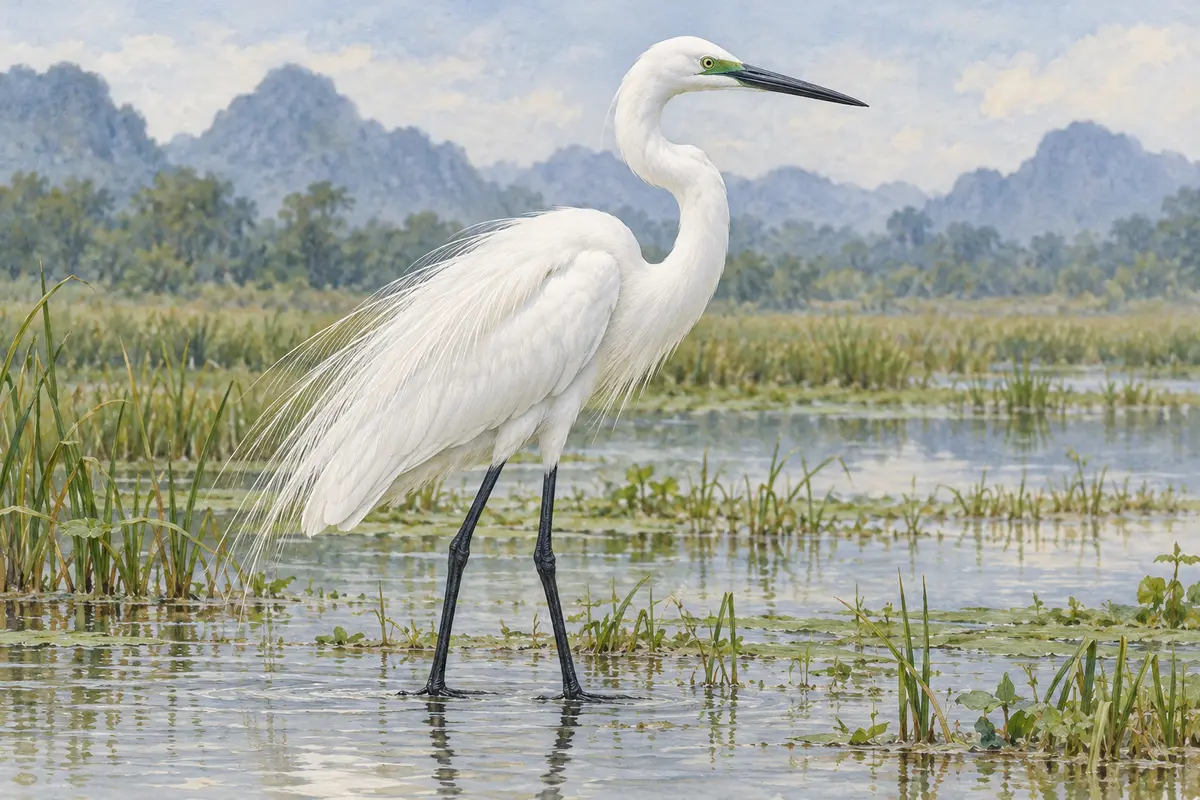
Ranges from South and East Asia through South-East Asia to Australia, New Zealand and Pacific islands; uses marshes, lakes, rice fields, rivers, estuaries and tidal flats. [1,4]
Species-level measurements are generally under 1 m in length, about 1 m tall, around 1.5 m in wingspan and roughly 0.9–1.14 kg; population and sex add variation. [3]
Entirely white with very long legs and neck. The bill is yellow outside breeding; breeding modesta typically develops a dark or black bill, green facial skin and long back plumes. [3,4]
The long S-folded neck acts like a spring, the pointed bill like a spear, and long legs permit hunting in deeper water than smaller egrets; long toes spread weight on soft mud. [3]
Behaviour and ecology
Often stands still or walks slowly before striking prey rapidly; flies with the neck retracted. Nests colonially, sometimes alongside other herons and ibises. [3]
Diet
Feeds on fish, frogs, crustaceans, insects, small reptiles and occasionally small mammals; proportions vary by wetland and season. [1,3]
Reproduction and life cycle
Species-level data: a stick nest in trees or shrubs near water; usually 3–4 eggs, incubated by both parents for about 23–24 days. Young begin flying at roughly six weeks. [3]
Ecosystem role
An aquatic predator linking fish, amphibians and insects to the waterbird community; nesting colonies move nutrients from feeding wetlands to nest trees or islands. [1,3]
Threats & conservation
The species is globally stable, but local populations face wetland loss, pollution, colony disturbance and altered water regimes. Feeding-site and nest-tree protection need local monitoring. [1,4]
Reviewed 22 October 2026: BirdLife/IUCN lists Ardea alba as LC; modesta has no separate global assessment and taxonomic treatments vary. The name was not located in current CITES Appendices; wildlife law still requires checking. [1,2,4]5 sourced facts
Species in five facts
The neck is retracted in an S during flight rather than extended like a stork's. [3]
The modesta bill darkens in breeding condition. [4]
Both parents incubate and feed the young. [3]
Nests often occur in mixed waterbird colonies. [3]
BirdLife/IUCN lists the parent species as LC. [1]
Sources
[1] BirdLife DataZone — Ardea alba[2] CITES — Appendices valid from 5 March 2026[3] University of Michigan ADW — Ardea alba[4] Australian Government — Ardea alba modesta conservation advice